AF PT Calculator

Updated March 2026 — DAFMAN 36-2905

Air Force PT Test Calculator

Calculate your composite score across all four components. Supports every exercise variant — push-ups, hand release, forearm plank, HAMR, and 2km walk.

2026 StandardsAll Exercise VariantsGoal CalculatorFree & No Login
Profile
15 ptsStrength
15 ptsCore Endurance
50 ptsCardio
:min : sec
20 ptsBody Composition

Scored by Waist-to-Height Ratio (WHtR). Lower ratio = higher score.

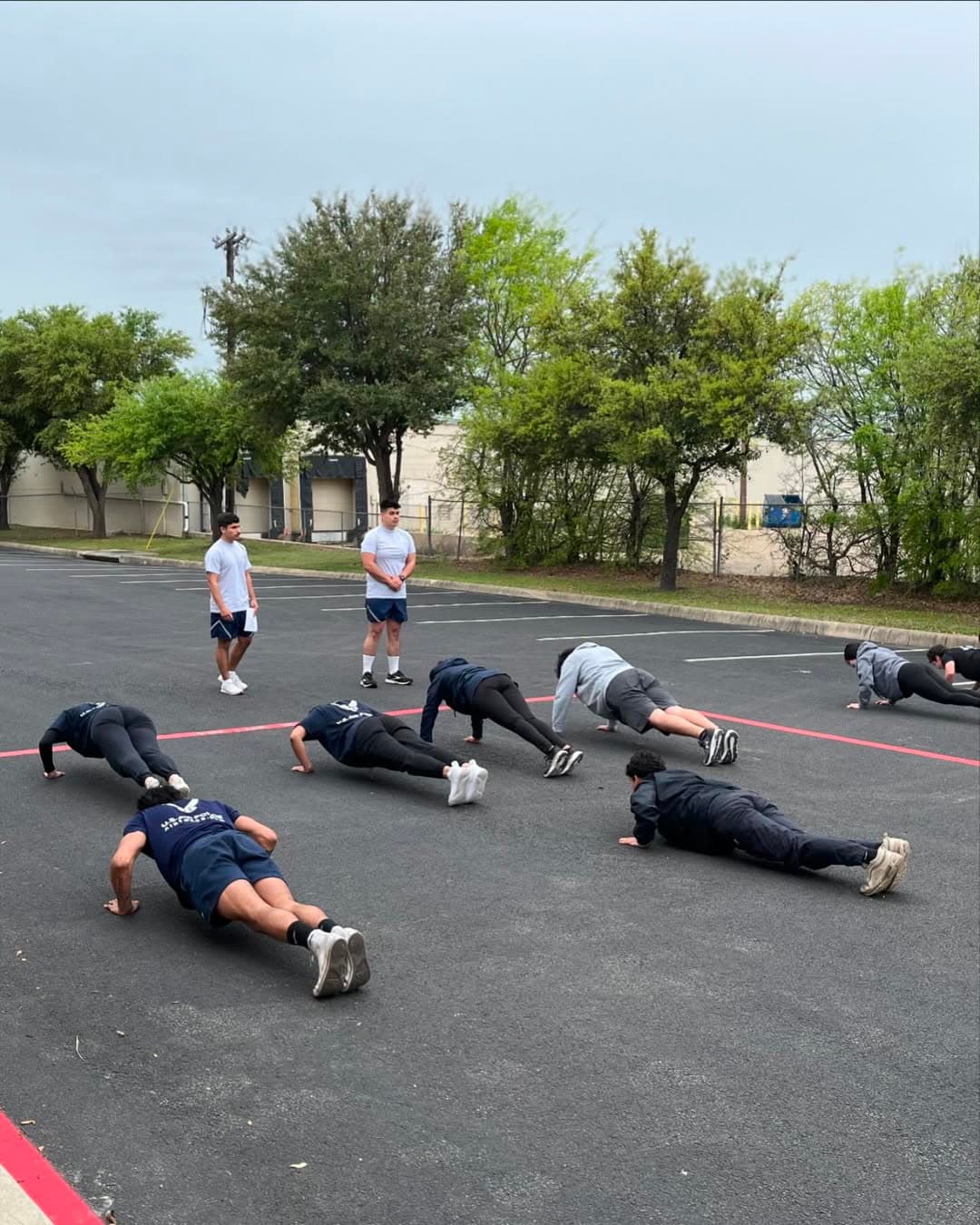
Air Force airmen performing push-ups during PT test

AF PT Events & Scoring

The PFRA (Physical Fitness Readiness Assessment) has four graded events worth 100 points combined. You need a composite of 75 or higher to pass. But a composite alone won't save you. Each event has its own minimum threshold, and failing any one of them is an overall no-go, full stop. Standards are from DAFMAN 36-2905, effective 1 March 2026.

15 ptsStrength
15 ptsCore Endurance
50 ptsCardio
20 ptsBody Composition
100 pts total

Excellent

90 – 100

Satisfactory

75 – 89.9

Unsatisfactory

Below 75

15 pts max

Strength

15% of composite score

How it works

Pick your variant before test day and stick with it. Your grader counts only reps that meet standard. No time cap, but the event ends the moment you break form or stop. One bad rep in a row and your grader will call it.

Exercise options

Push-ups (Standard)

Hands shoulder-width apart, body in a straight line from head to heels. Lock out at the top, chest comes within 2–3 inches of the deck on the way down. Your grader counts only clean reps. No sagging, no snaking.

Hand Release Push-ups (HR-PU)

Same starting position as standard push-ups, but at the bottom of every rep you lift your hands completely off the ground before pressing back up. Takes the bounce out of the movement and demands more raw strength per rep. Lower rep thresholds across the board.

Minimum to pass

Every age group and gender has a minimum rep count marked with an asterisk on the scoring chart. Drop below it and the component is a no-go, full stop, regardless of how well you did everywhere else.

Notes

  • Run your numbers through the AF PT calculator for both variants before test day. HR-PU thresholds are lower at the same point value. It's often the smarter pick if your max is in the mid-range.

  • Sagging hips, flared elbows, and not breaking the 2–3 inch mark are the three most common reasons reps get dropped. Your grader will not warn you mid-set.

  • There is no time limit, but resting in the up position is allowed. Resting on the deck is not.

15 pts max

Core Endurance

15% of composite score

How it works

Pick one and declare it before the Air force PT test. Sit-ups and cross-leg crunches are scored by rep count. The plank is scored purely on hold time. If you're strong in static holds and weak in reps, the plank can work in your favor.

Exercise options

Sit-ups

Fingers interlaced behind the head, knees bent at 90°, feet secured by a buddy. Drive up until both elbows touch both knees, then shoulders return to the floor. One full cycle is one rep. The most common choice across the force.

Cross-Leg Reverse Crunch

Flat on your back, arms at your sides, ankles crossed and legs raised to 90°. Drive your pelvis off the deck in a controlled crunch and return. Designed for Airmen dealing with neck or upper-body issues that make sit-ups a problem.

Forearm Plank

Forearms and toes on the deck, body rigid from head to heels. Your grader starts the clock when you hit the correct position. Clock stops the instant your hips drop, shoot up, or you collapse. Scored in minutes and seconds. No rep counting.

Minimum to pass

Each age group and gender has a minimum rep count (or hold time for the plank). Miss it and the component fails. Composite score doesn't matter.

Notes

  • For sit-ups, both elbows have to make contact with both knees every rep. If one elbow misses, the rep doesn't count. Graders watch for this.

  • The plank removes all rep-counting variables. If you can hold strong for 2+ minutes, run your numbers. It may score better than you think.

  • Cross-leg reverse crunches are the least common variant across units. If you're considering it, make sure you've drilled the form with someone who knows the standard.

50 pts max

Cardio

50% of composite score. The biggest mover on your PT card

How it works

Cardio is worth half your test. The 2-mile run is what most Airmen will face. The HAMR is an approved alternate at some bases. The walk requires prior coordination and medical justification. Don't show up expecting to walk without approval.

Exercise options

2-Mile Run

The standard go-to across almost every installation. Flat measured course or track, time recorded in minutes and seconds from gun to finish line. No adjustments for heat, humidity, or altitude. Know your course before test day.

20-Meter HAMR (High Aerobic Multi-level Run)

Shuttle run between two lines 20 meters apart, paced by an audio beep. Levels increase and beeps speed up as you go. Your score is the total number of completed shuttles before you fail to reach the line in time. Think of it as a beep test, approved at select installations.

2km Walk

Available for Airmen who can't perform running-based cardio, typically requiring medical justification. Complete the 2km course within your age/gender time standard. Pass/fail only. A passing time gets you the minimum cardio score (35.0 pts). No higher.

Minimum to pass

You need at least 35.0 points to pass cardio. That's the floor for the 2-mile run and also what a passing 2km walk awards. Drop below 35.0 on the run and the component fails regardless of composite.

Notes

  • Cardio is where PT scores are won and lost. Shaving 30 seconds off your run time can jump you multiple point increments depending on your age group. Check the calculator.

  • Know your 2-mile course before test day. Hills, turns, surface, and weather all affect your split times even if the official score doesn't account for them.

  • The HAMR is a legit VO2 max indicator. If you thrive on short intervals over sustained pacing, find out if your installation offers it.

20 pts max

Body Composition

20% of composite score

How it works

A trained FAC (Fitness Assessment Cell) tech takes a single tape measurement. Stand upright, arms at your sides, breathe normally. Any measurement taken on a held breath or a forced exhale is invalid. Height comes from your record or is measured on the day.

Exercise standard

Waist-to-Height Ratio (WHtR)

One tape measure, one number. Your waist is measured at the natural waist, narrowest point of the torso, typically just above the navel. That number is divided by your height in the same unit. Lower ratio means more points. Scoring is identical across all age groups and genders.

Minimum to pass

A WHtR of 0.60 or above is an automatic component failure. Zero points. You need 0.59 or below to pass, which gets you 2.5 points. Every 0.01 improvement below 0.59 adds points.

Notes

  • WHtR replaced the old absolute waist measurement in 2023. The change means taller Airmen get more credit for the same waist size. Frame matters now.

  • This is the one component you cannot fix the morning of your PT test. It's a long game.

  • The scoring table is universal. Same chart for a 22-year-old female and a 55-year-old male. Your ratio is your ratio.

All standards sourced from the official DAFMAN 36-2905 and PFRA Scoring Charts, effective 1 March 2026.

Group of Air Force trainees performing sit-ups during fitness assessment

AF PT Score Charts

Full scoring standards for every event, age group, and gender. All data from DAFMAN 36-2905, effective 1 March 2026.

Download official scoring charts (PDF)

Push-ups

Scored in reps

PointsUnder 2525–2930–3435–3940–4445–4950–5455–5960 and Over
15.0≥ 67≥ 63≥ 60≥ 56≥ 52≥ 49≥ 45≥ 42≥ 38
14.5666259555147444137
14.0646057535046434036
13.5635956524945423935
13.0615755514844413834
12.5605653494643393633
12.0585552484542383532
11.5575351474440373431
11.0555249454239363330
10.5545048444138353229
10.0524947434037343128
9.5514845413936333027
9.0494644403735322926
8.5484543393633302724
8.0464341383532292623
7.5454240363331282522
7.0434139353230272421
6.5423937343129262320
6.0403836323028252219
5.5393635312826242118
5.0373533302725232017
4.5363432282624211816
4.0343231272423201715
3.5333129262322191614
3.0312926242221181513
2.5302826232119171411
★ Minimum passing threshold — fall below this and the component fails
≥ prefix = minimum reps/time to earn that score
Air Force airmen running the 2-mile run event during PT test

DAFMAN 36-2905

Testing Standards

The rules governing how the PFRA is administered — how often you test, what happens after a failure, component minimums, and what exemptions exist.

Score tiers

Excellent

90–100

Tests every 12 months

Satisfactory

75–89.9

Tests every 6 months

Unsatisfactory

Below 75

Enters FIP — retest window set by commander

Testing frequency

Score tierNext test due
Excellent (90+)12 months
Satisfactory (75–89.9)6 months
Unsatisfactory (below 75)FIP — commander sets window

Component minimums — fail any one = overall failure

A composite of 75+ alone won't save you. Every component has a hard floor. Miss any one of them and the whole test is a no-go.

Strength15 pts max

Minimum rep count varies by age and gender. Drop below the starred row on the chart → component failure.

Core Endurance15 pts max

Minimum reps (or hold time for the plank) varies by age and gender. Drop below the starred row → component failure.

Cardio50 pts max

Minimum is 35.0 points. Score below that on the run and the component fails regardless of composite.

Body Composition20 pts max

WHtR of 0.60 or above = 0 points and automatic component failure. You need 0.59 or below to pass.

After a failure — FIP & consequences

FailureWhat happens
1st failureEnrolled in FIP. Retest window set by commander. No immediate adverse action.
2nd failureContinued FIP. Commander may issue a Letter of Counseling (LOC) or Letter of Admonishment (LOA).
3rd failureCommander may issue a Letter of Reprimand (LOR), initiate a promotion hold, or begin adverse personnel action.
Repeated failuresAdministrative separation action may be initiated under DAFI 36-3211. Commander retains discretion throughout.

Medical exemptions (DAF Form 469 required)

Exemptions are component-specific — you may be exempt from the run but still required to complete push-ups and body composition. All exemptions must be documented by a healthcare provider on a DAF Form 469 and uploaded in myFitness. Coordinate with your UFPM before your test window.

Pregnancy / post-partumTemporary injuryChronic conditionRecent surgeryDeploymentExtended TDYMedical profile

All standards from official DAFMAN 36-2905. Always confirm details with your UFPM.

Frequently Asked Questions

Common questions about the USAF Physical Fitness Readiness Assessment, testing frequency, scoring, and what happens when things go wrong.

What is a passing score on the Air Force PT test?

You need a composite score of 75 or above to pass. But the composite alone is not enough. You must also meet the minimum threshold for every individual component. Fail any single component (strength, core, cardio, or body composition) and the overall result is a failure, even if your composite is above 75.

How often do you have to take the AF PT test?

It depends on your score tier. Score Excellent (90 or above) and you test once every 12 months. Score Satisfactory (75–89.9) and you test every six months. The interval is tied to your calendar month. So if you test in April, your next window is either October (6-month) or the following April (12-month). Always confirm your due date with your Unit Fitness Program Manager (UFPM).

What happens if you fail the AF PT test?

A failed PT test (called an Unsatisfactory) gets documented in myFitness and triggers a Fitness Improvement Program (FIP). You'll retest within a set window determined by your commander. Multiple failures can result in adverse administrative action including promotion delays, reenlistment holds, or in repeated cases, separation. The exact consequences are outlined in DAFMAN 36-2905, Table A6.1.

Can you fail one component and still pass overall?

No. Every component carries its own minimum threshold. If you fall below the minimum on any single event. Even if your composite total is 75 or above, the entire assessment is a failure. For example, a WHtR ratio of 0.60 or above is an automatic component failure regardless of how well you performed on the run or push-ups.

What is WHtR and how is it measured?

WHtR stands for Waist-to-Height Ratio. It replaced the old absolute waist circumference measurement in 2023. A trained FAC (Fitness Assessment Cell) technician takes a single tape measurement at your natural waist, the narrowest point of your torso, typically just above the navel and divides it by your height in the same unit. Lower is better. The scoring table is universal across all age groups and genders. A ratio of 0.59 or below is required to pass.

What are the exercise options for each component?

Strength: standard push-ups or hand release push-ups. Core endurance: sit-ups, cross-leg reverse crunch, or forearm plank. Cardio: 2-mile run, 20-meter HAMR shuttle run, or 2km walk (walk requires prior medical justification and is pass/fail only). Body composition is always measured by WHtR. There are no alternatives.

What is the difference between standard push-ups and hand release push-ups?

Both start in the same position, but with hand release push-ups (HR-PU) you lift your hands completely off the ground at the bottom of every rep before pressing back up. This eliminates the stretch reflex and demands more strength per rep. The scoring tables are separate. HR-PU thresholds are generally lower at equivalent point values, so it can be worth running your numbers through the calculator for both variants before committing.

Can you get a medical exemption from part of the PT test?

Yes. Component-specific exemptions are granted for medical reasons and must be documented by a healthcare provider on a DAF Form 469 (Duty Limiting Condition Report). An exemption might cover the run but still require you to complete the strength and body composition components. Pregnancy, post-partum status, injuries, chronic conditions, and recent surgery are common reasons. Deployment and TDY-related exemptions also exist. Always coordinate exemptions through your UFPM and medical provider.

Does scoring Excellent (90+) get you any benefits?

Yes. The main benefit is a reduced testing frequency. Score 90 or above in all four components and your next PFA isn't due for 12 months instead of 6. Some units and commanders also recognise high fitness scores in performance evaluations, though this varies by chain of command.

Are the PT standards the same for all ages and genders?

No. Every component except body composition (WHtR) has separate scoring tables by age group and gender. Thresholds decrease with age. A 50-year-old is not expected to run the same time as a 25-year-old. WHtR is the only truly universal table: the same ratio and point values apply regardless of age or gender.